
Life, letters and low tide in Shetland: Valda and MacDiarmid


Christopher Grieve (Hugh MacDiarmid) and Valda Grieve in Whalsay. Copyright the Grieve Estate.
Introduction
There is a well-known story about the memorial service for writer, poet, and outspoken political commentator Hugh MacDiarmid. Rather than hold a minute's silence, poet Norman MacCaig suggested a more suitable tribute would be two minutes pandemonium.
In 'A Drunk Man Looks at the Thistle', arguably MacDiarmid's greatest and best-known work, he wrote ''I'll hae nae hauf-way hoose, but aye be whaur / Extremes meet'. Indeed, decades later Scottish writer and artist Alasdair Gray wrote that "early twentieth century Scottish literary life sank into stagnation from which only the creative violence of Hugh MacDiarmid stirred it" ('Studies in Scottish Literature' Volume XXX (1998), p.177-178.).
Such anecdotes suggest a man of intemperate character, volatile and radical, but Hugh MacDiarmid was the pen name created by Christopher Murray Grieve. What, then, of the man behind the pseudonym? Perhaps more intriguingly, what of Valda Trevlyn, with whom Grieve settled in Whalsay, Shetland, in 1933, along with their young son Michael?
Who was Hugh MacDiarmid?
Born in Langholm in the Scottish Borders in 1892, by 1926 Christopher Murray Grieve had established himself as arguably the most significant Scottish poet of his era. Or rather, he had established his alter-ego and pseudonym Hugh MacDiarmid as such. Following his return from serving in World War I with the Royal Army Medical Corps in France and Greece, Christopher spent time as a journalist, all the while writing poetry and argumentative political articles. He published these as Hugh M'Diarmid, or Hugh MacDiarmid, leading many to question the identity of this ubiquitous figure on the literary and political scenes.

The first edition of 'Northern Numbers' edited by C.M.G. (Christopher Murray Grieve), 1920.
From 1920 to 1922, Grieve edited the anthology 'Northern Numbers', which included some of his poems alongside those of other writers. The impact on Scottish literary culture was immense. He then published his own collections under the name Hugh MacDiarmid, with 'Sangschaw' and 'Penny Wheep' in 1925 and 1926 respectively. These were written using 'synthetic Scots', sometimes referred to as Lallans. It was a form which relied heavily on Scots dictionaries for vocabulary. The release of his most ambitious work to date, 'A Drunk Man Looks at the Thistle' in 1926, cemented his place as both forerunner and spokesman for a Scottish Renaissance that aligned with a new international modernism.
Having created such an instant and indelible impact, people were keen to find out who this MacDiarmid was. Christopher, however, was initially reluctant to emerge from behind his mask. At first, he only did so in private and amongst friends, revealing in 1923 to novelist Neil Gunn "I've a confession to make. I'm Hugh M'Diarmid". (National Library of Scotland archives, Dep.209/17/3).

Grieve writes to Neil Gunn on 1 November, 1923 [Reference: Dep.209/17/3].
In addition to the poetry, he was ever present in newspaper letters columns, penning ferocious tirades against cultural and political opponents. His belief in a new form of poetic and artistic expression in Scots aligned for a period with his political outlook. He was an early member of what would later become the Scottish National Party. Subsequently he was deemed too extreme and banished from the party, whom he called, with typically MacDiarmidian restraint, "a troupe of gibbering lunatics" (Quoted in Bold, p.332), Perhaps his greatest achievement was that his expulsion from the Nationalists was followed with expulsion from the Communist Party for harbouring nationalist ideas.
Introducing Valda Trevlyn
His first marriage to Peggy Skinner had ended in divorce with the dismaying outcome of his not seeing their two children for decades. This would continue to weigh heavily on him, but by 1932 he was in a relationship with Valda Trevlyn, and their son Michael was born in July of that year.
Valda was a native of Bude, Cornwall, and she was politically aware, being a supporter of both Cornish independence and Communism. Her reasons for taking up with Christopher, however, are rather comic, and speak to her no-nonsense yet nurturing, protective nature. Speaking in 1984 she said:
"I didn't really believe in the business of 'Hugh MacDiarmid' or any of that: this business of being a Scottish poet was all baloney. What really decided me was when I was standing in the Tottenham Court Road. Christopher had gone down to the lavatory and had gone into the women's. I thought, 'Oh, my God, I can't leave him'".
Valda, quoted in Alan Bold's 'MacDiarmid' (1990), p.303.

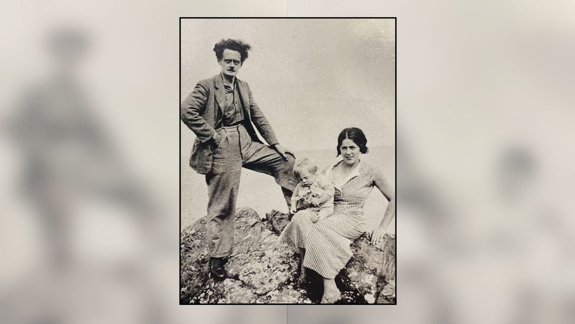
Christopher, Valda, and Michael Grieve in Whalsay. Copyright the Grieve Estate.
Arriving in Whalsay: A harsh new beginning
Not long after his son was born, Christopher was at a low ebb, with money in very short supply. Through his friend in Edinburgh, Helen Cruickshank, he hears of free board at a house in Whalsay, Shetland. Christopher immediately arranges to move Valda and nine-and-a-half-month-old Michael to the island, in what was initially intended as a temporary change.
Free accommodation and solitude would give Christopher the opportunity to focus on writing, which was their only source of income. He also struggled with alcohol, so Whalsay being a dry island, supposedly, was also a factor.
Christopher arrived in Whalsay early May 1932, with Valda and Michael joining him in June. It's here, in 1933 that we pick up the story. The contrast in personalities between Valda and Christopher are evident in his own words from his autobiography 'Lucky Poet', where he writes:
"Comfort never mattered very much to me [and] I am not a 'knacky' person; what furniture we had at the beginning was made for the most part by my wife out of orange boxes, tea boxes, and the like."
Valda is clearly the more practical of the two. It would become apparent that without her at the helm, they were doomed.

Christopher and Valda Grieve in Whalsay. Copyright the Grieve Estate.
Poverty, poetry and pressure
Money from publishing was slow to materialise. He managed a trip to the Faroe Islands and continued to write at breakneck speed. The local scenery inspired his 'Shetland Lyrics', published as part of 'Stony Limits and Other Poems' in 1934, along with his greatest mid-career work, 'On A Raised Beach', inspired by the island of West Linga, another site of numerous visits.
While the landscape of Shetland provided beauty and inspiration, conditions on Whalsay were difficult. The North Atlantic weather, initially delightful, would also prove challenging.
Money matters were so bad that on a visit to London, Christopher ended up sleeping rough, having no funds for accommodation. Around this time his health and their financial struggles became impossible to ignore.
This is clear in one of the letters in our collection, which shows Valda's anxiety at their situation. Writing from her hometown of Bude, she is unflinching in her criticism of Christopher and his evasiveness regarding money and her Post Office Savings Book. She writes, "I wish you'd be truthful for once & tell me whether you've had it or not - or done anything with it. It hurts me to ask you like this, but you let me down before in this way" (Letter from Valda to Christopher, National Library of Scotland archives). Their contrasting approaches to money would continue to be a source of friction.
Clearly now part of the community in Whalsay, Alan Bold notes:
"MacDiarmid saw in the New Year of 1935 quietly but had forgotten that the islanders started their celebrations on 7 January. By 7 p.m. that Monday night, MacDiarmid's cottage was crammed with twenty-five men. As it was obligatory for every man to sample every other man's bottle, the busy poet reverted to his role of drunk man – when Helen Cruickshank had advised MacDiarmid to go to a dry island she did not anticipate that the absence of bars had little to do with the availability of alcohol." (Quoted in Bold, p.377).
Breakdown, barriers and daily graft
1935 did not bring relief from their struggles. Overwork, ill health, and a court case involving his ex-wife took their toll. By August 1935 Christopher was being treated in Perth for a complete nervous breakdown.
Valda returned to Whalsay, and Christopher soon followed, but 1936 brought no respite, with several writing projects not making it to publication. There was also a fall out with Edwin Muir, and a second loss in his attempt to become Rector of the University of Edinburgh.

'Shags' Nests' [Reference: National Library of Scotland, MS.27030, f.2]. Copyright The Estate of Christopher Murray Grieve.
The landscape of Shetland continues to filter into the work of MacDiarmid. The poem 'Shags' Nests', one of his 'Shetland Lyrics', has the narrator lamenting "the death-bound spirits o' men / That, climbin', I've left behind me". In reality, at the time of writing it was only Valda who scaled the cliffs to collect eggs, yet it finds its way into MacDiarmid's poetic vision. It's evidence again of Valda's practicality, strength, and endeavour coming to the fore. The eggs will be pickled and provide food for the winter months. Christopher would only later climb to collect eggs during the war years, when times were extremely tough.
It's a distinction that locals were acutely aware of. While Christopher wrote philosophical poetry as Hugh MacDiarmid, Valda got on with the hard work of surviving and providing. She also fit in with the community in a way that Christopher did not. He did himself no favours on this front, repeatedly denigrating the locals and their lack of culture. Valda recalled one such occasion when she and some Whalsay fishermen gathered at the local shop to listen to MacDiarmid live on BBC radio, only for him to disparage the entire Shetland literary tradition, annoy the locals, and embarrass Valda.
But Christopher did not have it all his own way, and the islanders often outsmarted him. On a fishing trip in 1936, he spent the entire time writing, with his interest in the local dialect leading to humour at the poet's expense. One of the crew relates the following scene:
"Wilfred called da men ta come for der dinner or something, an he gies a great roar: "Scaramadoo!" An Grieves shot his head oot aa bed an glowered at Wilfred, all excited, an said, "What word was that?! What word was that?!" He tocht dis was a right wird at we used, but hit wis just a lok o dirt at Wilfred wis made up" (quoted by Brian Smith, from 'MacDiarmid in Shetland', p.51).
Translation: "Wilfred called the men to come for their dinner or something, and he gives a great roar: "Scaramadoo!" And Grieves shot his head out of the bed and glowered at Wilfred, all excited, and said, "What word was that?! What word was that?!" He thought this was the right word that we used, but it was just a lot of dirt that was made up."
Knitting, grit and hard truths
One can't help but sympathise with Valda. Later, she takes up knitting extremely complex Fair Isle garments, eventually becoming so adept that she could raise funds for the family's coffers through their sale.
It's perhaps no surprise then, that Valda's September 1937 letter to Christopher contains her forthright anger at his spendthrift tendencies, and a formidable expression of her lack of patience at his antics. She writes, "this holiday should really do you the world of good & there will really be no excuse when you come back to say you're on the brink of a nervous breakdown". (Letter from Valda to Christopher, National Library of Scotland archives).
Given Christopher's mental health issues two years prior, this sounds somewhat harsh. However, Valda has learned he has been borrowing money despite having a generous amount available for his holiday. Michael, now aged five, has boots that leak and ill-fitting clothes. "Surely you have some control over yourself", she writes, continuing, "Because you have brains you think, I believe, that you can do anything - & expect everything from me - Expect on, Laddie". (Letter from Valda to Christopher, National Library of Scotland archives). It's a robust rejoinder, and further evidence of her impressive capacity to keep the wayward poet in check.

Letters and manuscripts of Valda and Christopher Murray Grieve from the Library archives. Copyright the Grieve Estate.
In addition to her efforts to support her family and enable Christopher to devote his time to his writing, Valda also finds time for her own interests. In 1938 she joins Grant Taylor, who had come to Whalsay to work as an assistant to Grieve, and local doctor David Orr, in a performance of Chekhov's 'The Bear'. It's clear evidence of Valda's own creative energies. It's also apparent that Christopher was far from the only member of the household with artistic aspirations. An award of £125 from the Royal Literary Fund in May of 1938 greatly eased some of their debt burden.
The family struggled on in relative poverty, and the announcement of War in September 1939 meant they all remained on Whalsay until 1942. 1939 also brought about what Brian Smith calls "Grieve's finest hour on Whalsay", when the local County Assessor raised rates just as the war was announced. (Quoted by Brian Smith, from 'MacDiarmid in Shetland', p.61). Christopher writes to the 'Shetland News' demonstrating the utter lack of return for such rates:
"They had no lighting, sewage, scavenging or other public services […] He did not know why the people of Hamister paid any rates at all when in the winter owing to the absence of any road they had to flounder through a bog to get to their houses".
The campaign was unsuccessful, but Christopher's stock undoubtedly went up in the estimation of Whalsay's inhabitants.
Leaving Whalsay behind
We join Christopher now in the central belt, while Valda and Michael remain in Whalsay, preparing for their move to join him. Writing from Glasgow in 1942, Christopher himself provides further evidence of Valda's indomitability. Addressing her as "Dearest Hen-Bird", he outlines the challenges Valda currently faces; snowdrifts, a walk of over a mile to the well for water and to the shop for milk, all with an injured knee.
He hints at previous misadventures when he reassures her that "you need not fear I've got into trouble of any kind. I'll not go off the rails in any way at all". That said, it is one of the rare occasions during these years where, despite the ongoing war, he is hopeful about their prospects and writes that he is "not exaggerating at all when I sound hopeful and promising. I honestly do think we've a real chance here". (Letter from Christopher to Valda, National Library of Scotland archives).
Valda's reply on 25 February is a mix of fear at the threat of a German invasion of Shetland, with customary directness. She summarises the efforts of the local Home Guard as "a bloody farce", with rifle practice revealing only one local able to hit the target out of a thousand bullets. She touches on politics and MacDiarmid's writing, and clearly misses him, saying "it's not half so much fun just baking for oneself" (Letter from Valda to Christopher, National Library of Scotland archives).
By June of 1942 matters are even worse: "What in hell are we going to do – I can't live up here on air - & you can't either." The cupboards are almost bare, and it's clear that Valda and Michael must also leave Whalsay and join Christopher in Glasgow "as soon as possible – for our sakes" (Letter from Valda to Christopher, National Library of Scotland archives). Valda's last letter from Shetland is dated 2nd October 1942. She has clearly been struggling to clear the house and pack up their belongings, including their vast library. She writes: "I'm not worrying yet how we'll manage at your end – I've enough worries this end to contend with". (Letter from Valda to Christopher, National Library of Scotland archives).

Valda Trevlyn. Copyright the Grieve Estate.
The woman behind the work
The fact that MacDiarmid was able to produce such a prodigious volume of writing during the Shetland years was in large part due to Valda. Her letters to Christopher would be published as 'Scarcely Ever Out of My Thoughts: The Letters of Valda Trevlyn Grieve to Christopher Murray Grieve (Hugh MacDiarmid)'. In her introduction to the volume, Beth Junor writes that not only was it the case that "Valda was the sustenance for Grieve's intellect and creativity", but that no-one "could have done a better job than Valda in teaching Christopher how to attend to practical considerations affecting others."
Junor encapsulates just how crucial Valda was, and how she managed to resolve the duality of Christopher Murray Grieve and Hugh MacDiarmid. It was Valda who was "to insist Christopher Murray Grieve remain fully 'in this world' and connected to others (and hence have the capacity to express this in Hugh MacDiarmid's work)". (Beth Junor, pp.xvi-xvii),
It outlines the dichotomy of the Grieve / MacDiarmid character. Put him on a stage or in front of a microphone, or give him a pen, and he became the outspoken MacDiarmid, liable to denounce all and sundry. Yet in person he could be pleasant, funny, and easy company, at least some of the time. But without Valda, it's difficult to imagine him surviving the Shetland years, and remaining capable of writing at all.
Following Shetland, in 1951 Valda and Christopher settled at Brownsbank Cottage near Biggar, with Margaret Tait's film capturing their lives spent there until his death in 1978. Valda lived until 1989. Their Shetland years remain fascinating to anyone with an interest in modern Scottish culture, and the influence of a heroic Cornish woman upon it.
Acknowledgements
Unless noted, all quotations courtesy of The Estate of Christopher and Valda Grieve.
Images of letters and manuscripts copyright of The Estate of Christopher and Valda Trevlyn Grieve, used with kind permission.
About the author
Colin is curator of Modern Literary Manuscripts at the National Library of Scotland.
Dive deeper
Papers of Christopher Murray Grieve

Come and see our collections
